Business · February 7, 2026 · 4 min read
Profit Margin vs Markup: What's the Real Difference?
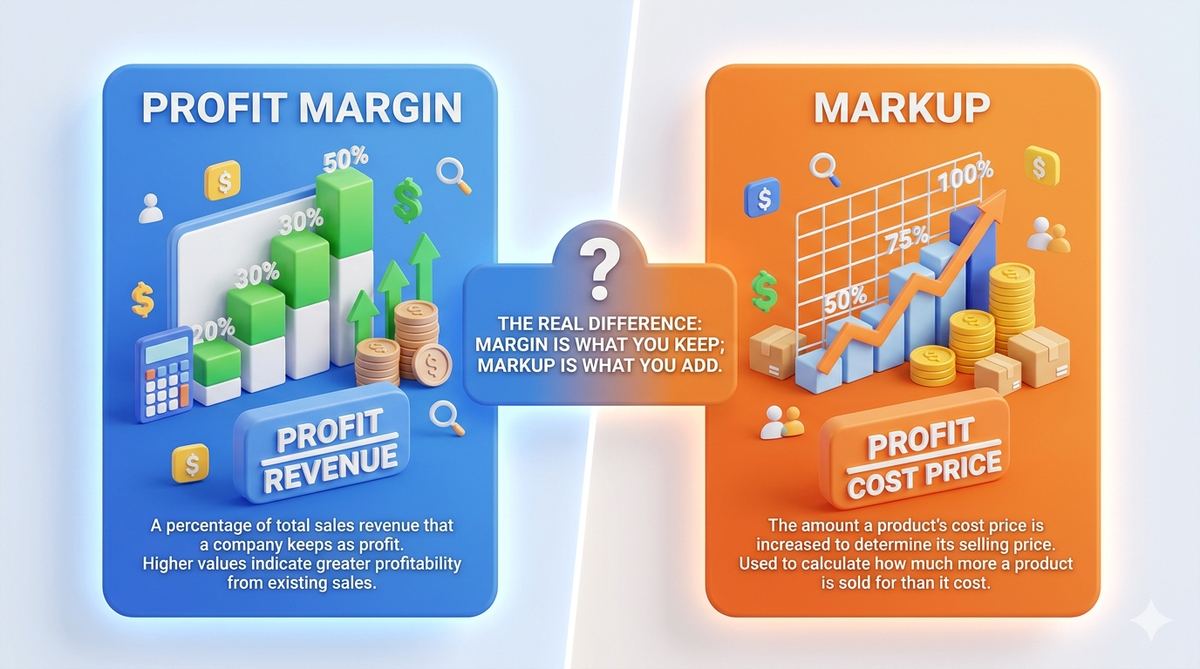
These two terms both describe profitability, and they're often used interchangeably in casual conversation — but they're calculated differently and produce different numbers for the exact same sale, which matters when setting prices or evaluating a business.
Markup: profit as a percentage of cost
Markup measures profit as a percentage of what the item cost you to acquire or produce. If an item costs $40 and you sell it for $60, your markup is $20 divided by the $40 cost, which equals 50%.
Margin: profit as a percentage of selling price
Profit margin measures the same $20 profit, but as a percentage of the $60 selling price instead of the cost. That's $20 divided by $60, which equals about 33.3% — a notably different number than the 50% markup, despite describing the exact same transaction.
Why this distinction actually matters
Because markup and margin use different denominators (cost vs. selling price), a given markup percentage always produces a lower margin percentage on the same sale. Confusing the two can lead to pricing mistakes — for example, assuming a 50% markup delivers a 50% margin, when it actually delivers a smaller margin.
This distinction matters most when setting prices to hit a specific profitability target: solving for a target margin requires different math than solving for a target markup, even though both describe 'how profitable' a sale is.
Solving for a target margin correctly
If you want a 40% profit margin on an item that costs $40 to produce, the correct selling price is $40 divided by (1 − 0.40), which equals $66.67 — not simply $40 plus 40% ($56), which would only produce a lower margin than intended. This is a common pricing mistake worth avoiding.
Frequently Asked Questions
Related Calculators
Published February 7, 2026. This article is for general informational purposes only — read our disclaimer.