Business · February 8, 2026 · 5 min read
How to Calculate Your Business's Break-Even Point
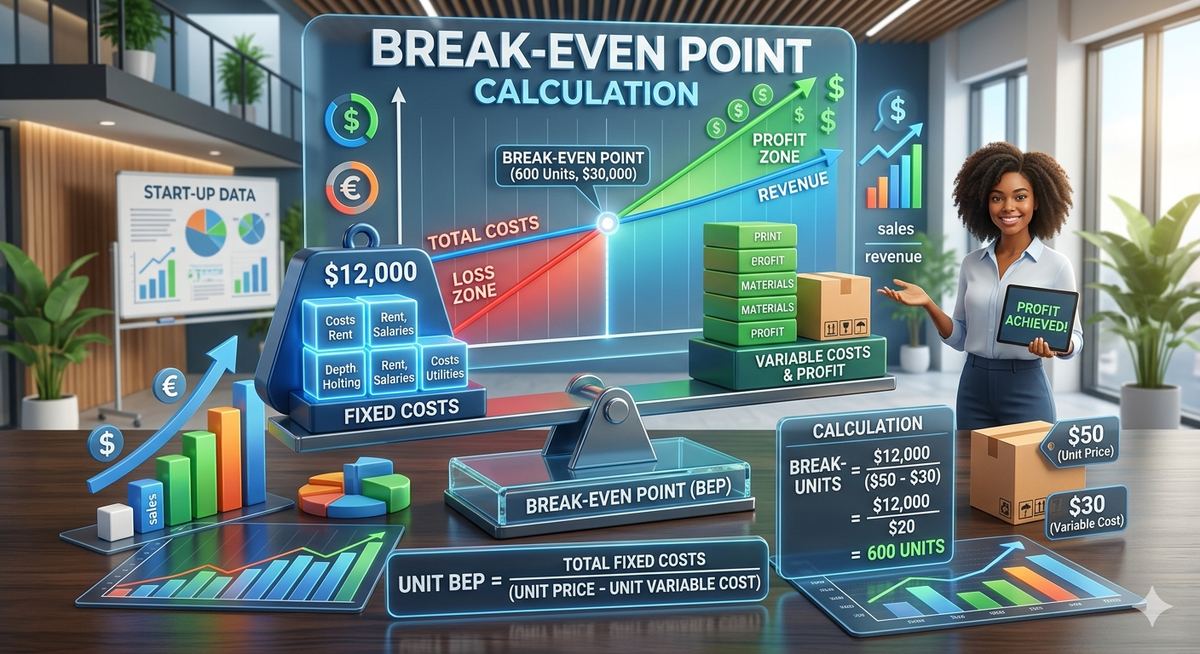
Before a business turns a profit, it first needs to cover its costs — the break-even point is the exact sales volume where total revenue equals total costs, with zero profit or loss. Knowing this number is foundational for pricing, budgeting, and evaluating whether a business idea is viable.
The two types of costs involved
Fixed costs stay the same regardless of how much you sell — rent, salaries, insurance. Variable costs scale with each unit sold — materials, direct labor, shipping. Break-even analysis separates these two cost types because they behave differently as sales volume changes.
The core formula
Break-even units equals fixed costs divided by the contribution margin per unit, where contribution margin is your selling price minus your variable cost per unit. This tells you exactly how many units you need to sell before fixed costs are fully covered.
Once you've sold enough units to reach break-even, every additional unit sold contributes its full contribution margin directly to profit, since fixed costs are already covered — which is why sales beyond break-even are often disproportionately profitable.
Why this matters for pricing decisions
Break-even analysis reveals how sensitive your business is to price changes. A small price increase can meaningfully lower your break-even point, since it increases the contribution margin on every unit — while a price decrease raises the number of units you need to sell just to cover costs.
Using it to evaluate a new product or business idea
Comparing your calculated break-even volume against realistic sales expectations for your market helps assess whether an idea is financially viable before committing significant resources — if the required break-even volume seems unrealistic for your market size, that's a meaningful red flag worth addressing before launch.
A worked example
With $20,000 in fixed costs, a $50 selling price, and a $20 variable cost per unit, the contribution margin is $30 per unit. Break-even units equal $20,000 divided by $30, which is about 667 units. Selling fewer than 667 units results in a loss; selling more results in growing profit.
Frequently Asked Questions
Related Calculators
Published February 8, 2026. This article is for general informational purposes only — read our disclaimer.