Salary & Paycheck · January 30, 2026 · 5 min read
How Your Paycheck Tax Withholding Actually Works
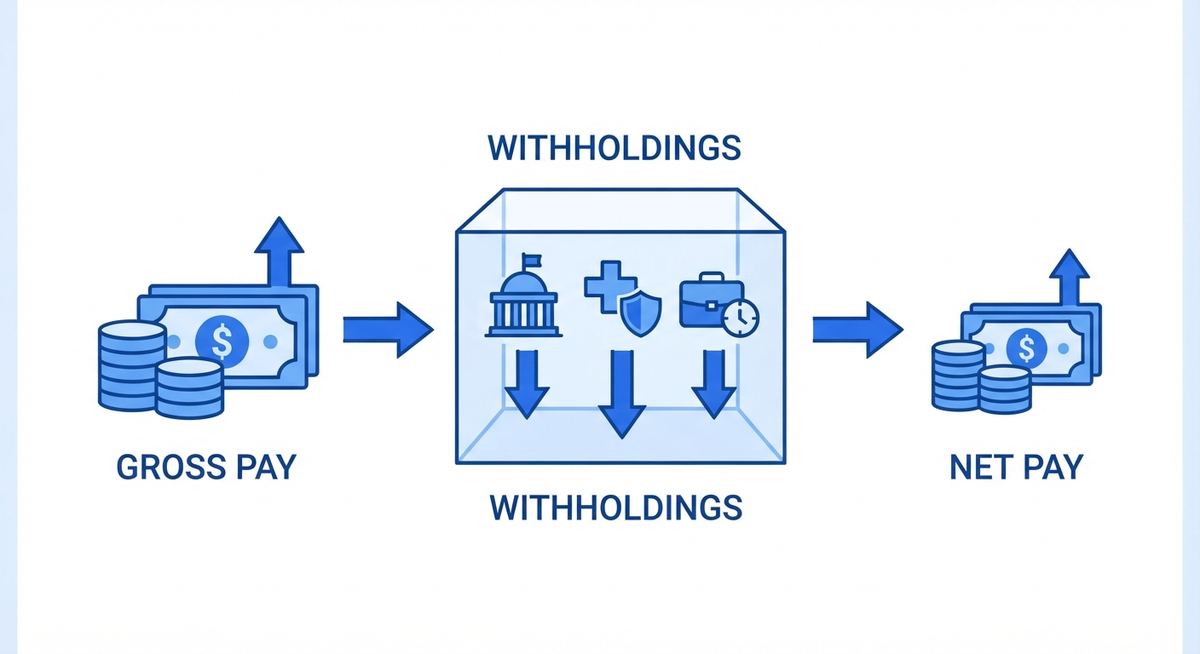
Every paycheck, a portion is withheld and sent directly to the government on your behalf — but the exact amount depends on more than just your salary, and understanding the mechanics can help you avoid both a surprise tax bill and an unnecessarily large refund.
What determines how much is withheld
Your employer withholds based on the information you provide on Form W-4, combined with IRS withholding tables. Key inputs include your filing status, whether you have multiple jobs, dependents you're claiming, and any additional withholding you request.
Separately, FICA taxes (Social Security and Medicare) are withheld at fixed rates regardless of your W-4 — these aren't adjustable the way federal income tax withholding is.
Why a big tax refund isn't actually a bonus
A large refund means you had too much withheld throughout the year — effectively giving the government an interest-free loan of your own money, which you only get back after filing your return. Many people prefer this as a forced savings mechanism, but from a pure cash-flow perspective, adjusting your withholding to more closely match your actual tax liability puts that money in your paycheck throughout the year instead.
Why under-withholding is riskier
If too little is withheld, you may owe a balance when filing — and potentially an underpayment penalty if the gap is large enough. This commonly happens with side income, multiple jobs, or significant life changes (marriage, new dependents) that aren't reflected in your current W-4.
When to update your W-4
Common triggers include a new job, marriage or divorce, a new dependent, a significant income change, or simply noticing a large refund or balance due on your most recent tax return. You can submit a new W-4 to your employer at any time — it's not limited to open enrollment periods.
A quick withholding check
If you've withheld $6,000 in federal tax through 12 of 26 biweekly pay periods, you're on pace for roughly $13,000 for the year. Comparing that projection to your actual estimated tax liability for the year tells you whether you're on track, under-withheld, or over-withheld — and whether a W-4 adjustment makes sense before year-end.
Frequently Asked Questions
Related Calculators
Published January 30, 2026. This article is for general informational purposes only — read our disclaimer.