Mortgage & Real Estate · February 9, 2026 · 6 min read
How Much House Can You Actually Afford?
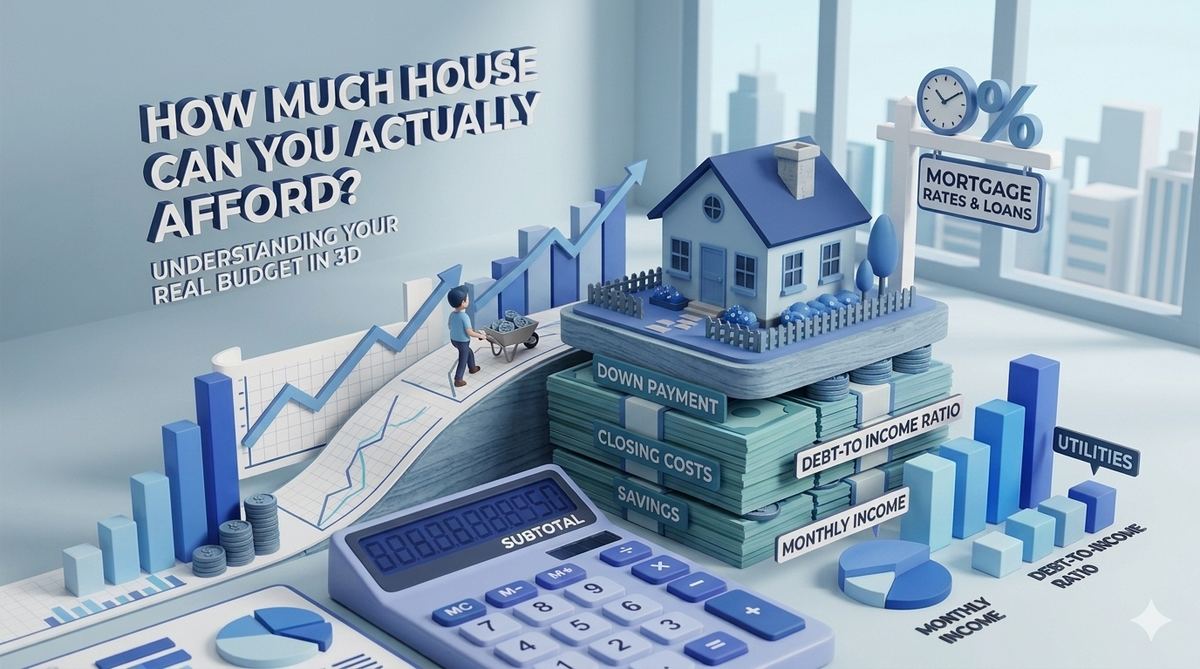
Before house-hunting, most guidance points to one question: how much can you actually afford? The honest answer has two parts — what a lender will approve you for, and what actually fits comfortably in your budget. These aren't always the same number.
The 28/36 rule lenders actually use
Most conventional lenders apply a guideline known as the 28/36 rule: your housing payment shouldn't exceed 28% of your gross monthly income, and your total debt payments — housing plus everything else — shouldn't exceed 36%.
You can run your own numbers through a Mortgage Affordability Calculator to see exactly where these two limits land for your income and existing debts, rather than guessing.
Why the approved amount isn't always the smart amount
Lenders calculate the most they're willing to lend, not necessarily what leaves you with a comfortable financial cushion. Two households with identical approved amounts can have very different actual budgets left over once other expenses — childcare, retirement savings, an emergency fund — are factored in.
A common practical adjustment: calculate your lender-approved maximum, then consciously target 80-90% of it, keeping the difference for flexibility.
How down payment size changes the picture
A larger down payment doesn't just reduce your loan size — it changes your monthly payment enough to meaningfully shift what home price fits your budget. Testing a few different down payment amounts with a Mortgage Calculator shows exactly how much room a slightly bigger down payment buys you.
A worked example
On a $90,000 annual income with $400/month in existing debt, the 36% back-end limit allows roughly $2,300/month for housing. At a 6.5% rate with $40,000 down, that translates to an affordable home price in the neighborhood of $400,000 — a concrete number to shop with, rather than an open-ended guess.
Frequently Asked Questions
Related Calculators
Mortgage Affordability Calculator
Estimate the maximum home price you can afford based on your income and debts.
Mortgage Calculator
Estimate your monthly mortgage payment and view the full amortization schedule.
Down Payment Calculator
See how much cash you need for a down payment, and whether you'll need PMI.
Published February 9, 2026. This article is for general informational purposes only — read our disclaimer.