Investment · February 15, 2026 · 5 min read
How Compound Interest Builds Retirement Wealth Over Time
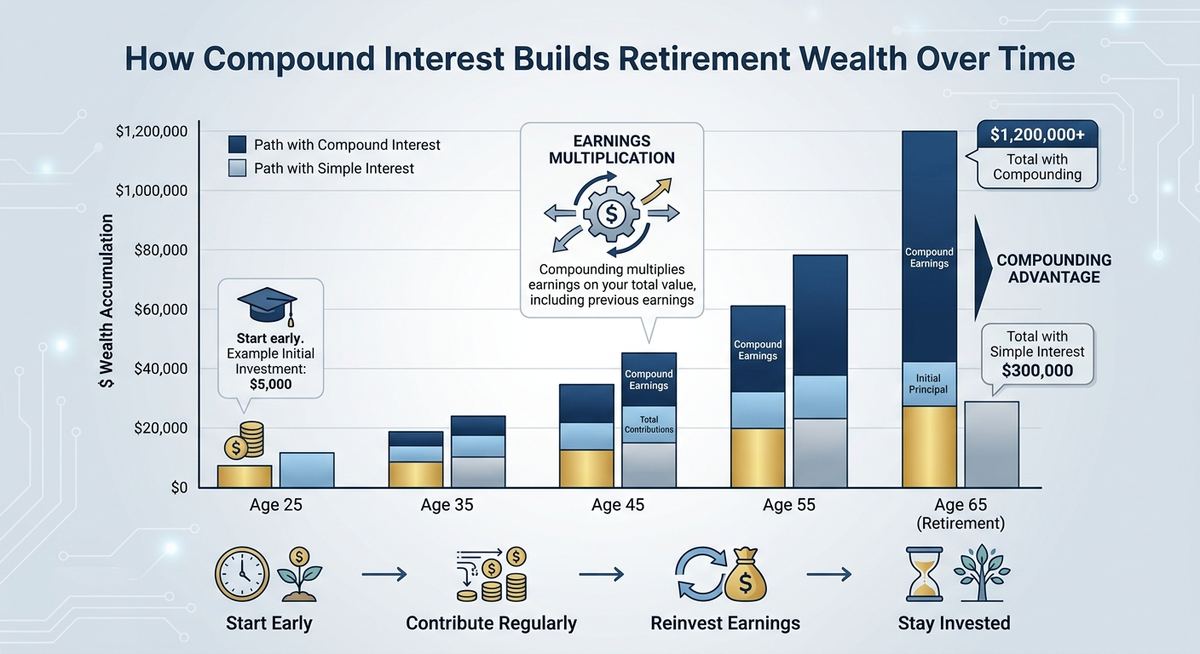
Retirement accounts benefit from compound interest more than almost any other financial tool, simply because of the time involved — decades of contributions and growth compounding on top of each other.
Why the retirement timeline is compound interest's ideal setting
A typical working career spans 30-40 years, giving contributions made early in that span far more time to compound than contributions made near the end. This is why starting retirement savings early is emphasized so consistently in financial guidance.
Regular contributions compound alongside your starting balance
Retirement accounts rarely grow from a single lump sum alone — regular contributions each pay period add new principal that then has its own remaining time to compound. Modeling this with a Retirement Calculator shows how contribution consistency compounds into a very different outcome than the contributions alone would suggest.
Employer matching adds a second compounding stream
For workplace retirement accounts with an employer match, that matched money also compounds over the same time horizon — effectively doubling the growth engine on the matched portion. A 401(k) Calculator factors in both your contributions and the match to project the combined effect.
A long-horizon example
Contributing $500/month starting at age 25, at a 7% average annual return, grows to roughly $1.2 million by age 65. Starting the same $500/month contribution at age 35 instead — just 10 years later — grows to only about $566,000 by the same age 65, despite contributing for 30 years instead of 40. The missing decade of compounding accounts for the majority of that gap.
Frequently Asked Questions
Related Calculators
Retirement Calculator
Project how much you'll have saved by your target retirement age.
401(k) Calculator
Project your 401(k) growth including employer match, checked against IRS contribution limits.
Compound Interest Calculator
See how your money grows over time with compounding and optional monthly contributions.
Published February 15, 2026. This article is for general informational purposes only — read our disclaimer.