Salary & Paycheck · February 20, 2026 · 5 min read
Freelance vs Salaried Income: What Changes for Your Taxes
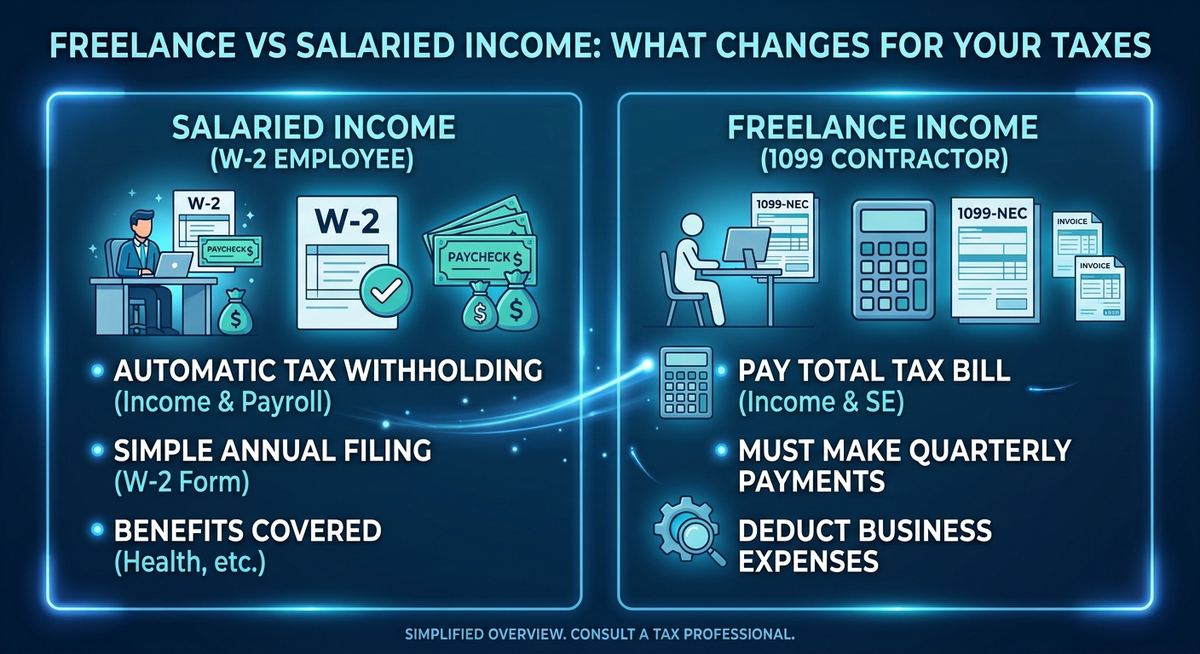
Moving from salaried employment to freelance or contract work changes more than just how you get paid — it fundamentally changes how and when your taxes are calculated and owed, in ways that catch many new freelancers off guard.
No automatic withholding means you're on your own
As a salaried employee, your employer withholds and remits taxes on your behalf throughout the year. As a freelancer, no one withholds anything — the full responsibility for setting aside and paying taxes shifts to you.
Self-employment tax is a real, often-overlooked cost
Salaried employees split Social Security and Medicare tax with their employer, each paying 7.65%. Freelancers are considered both employee and employer, owing the full 15.3% combined rate themselves — a cost many new freelancers don't budget for. A Self-Employment Tax Calculator shows exactly what this adds up to on your net profit.
Quarterly estimated payments replace paycheck withholding
Instead of taxes coming out of each paycheck, freelancers generally need to make estimated tax payments four times a year, covering both income tax and self-employment tax. An Estimated Tax Calculator combines both obligations into a single quarterly payment estimate based on projected annual profit.
Deductible business expenses work differently
Freelancers can typically deduct legitimate business expenses — equipment, home office costs, software subscriptions — directly against their income before calculating tax, an option salaried employees generally don't have for their regular job expenses.
The self-employment tax gap
On $80,000 in net freelance profit, self-employment tax alone adds roughly $11,300 on top of regular income tax — a cost a salaried employee earning the same amount simply wouldn't see broken out separately, since half of an equivalent cost is already absorbed by their employer.
Frequently Asked Questions
Related Calculators
Self-Employment Tax Calculator
Calculate your Social Security and Medicare tax as a self-employed worker.
Estimated Tax Calculator
Calculate your quarterly estimated tax payments as a self-employed worker.
Income Tax Calculator
See a full bracket-by-bracket breakdown of how your income tax is calculated.
Published February 20, 2026. This article is for general informational purposes only — read our disclaimer.