Debt & Credit · January 24, 2026 · 6 min read
How to Pay Off Credit Card Debt Faster (Without a Miracle)
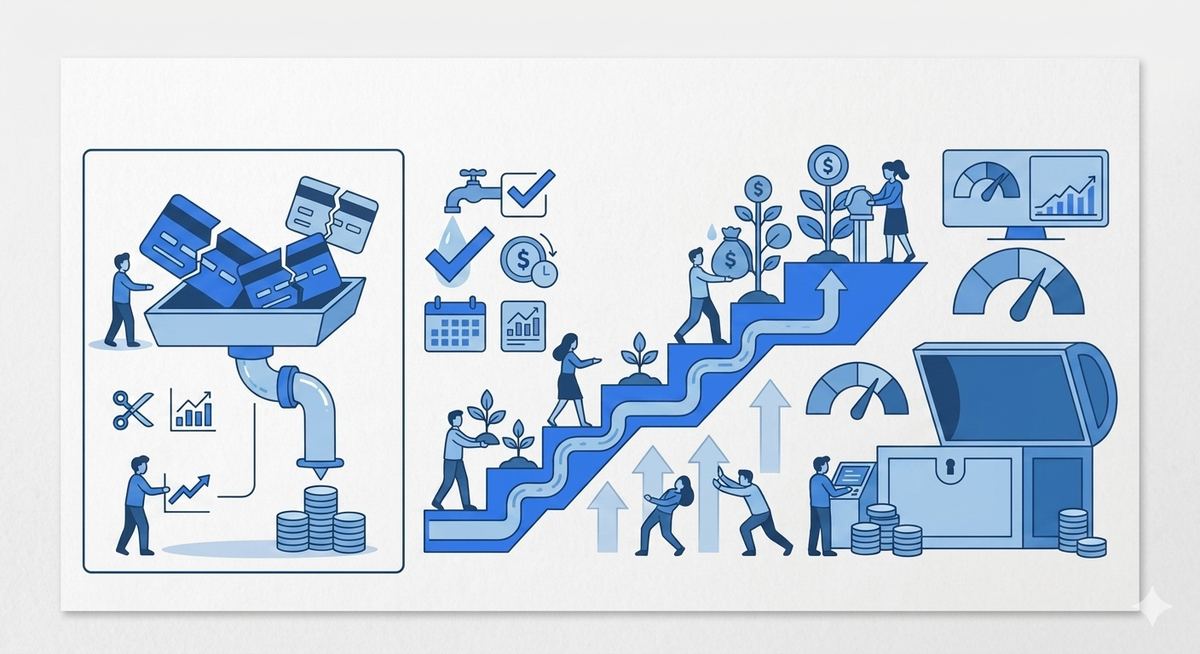
Credit card debt is uniquely difficult to escape because of how minimum payments are structured — they're designed to keep you paying for a very long time. Understanding why, and what actually breaks that cycle, makes a real difference.
Why minimum payments barely move the balance
Credit card minimum payments are usually calculated as a small percentage of your balance — commonly 1-3% — plus interest. Because the required minimum shrinks as your balance shrinks, paying only the minimum can stretch a modest balance into a decade or more of payments, with total interest sometimes exceeding the original balance.
The single most effective change: a fixed extra payment
Adding any fixed extra amount on top of the minimum — even $50 or $100 — breaks the shrinking-payment cycle and dramatically shortens the payoff timeline, since more of every payment goes toward principal instead of interest.
The exact impact depends on your balance and interest rate, but even modest consistent extra payments routinely cut payoff time by half or more compared to minimum-only payments.
Choosing which debt to attack first, if you have multiple cards
If you're juggling multiple balances, two common strategies apply: the avalanche method (extra payments go to the highest-interest-rate card first, minimizing total interest) and the snowball method (extra payments go to the smallest balance first, for faster psychological wins).
Mathematically, avalanche saves more money. Practically, snowball keeps some people more motivated by eliminating individual balances faster. Either is far better than spreading extra payments evenly across all cards.
Consider a balance transfer or personal loan, carefully
A 0% introductory APR balance transfer card can pause interest accrual entirely for a promotional period, letting your payments go entirely toward principal — but only if you have a plan to pay it off before the promotional rate ends, since rates typically jump significantly afterward.
A personal loan at a lower fixed rate than your card's APR can also reduce interest cost, though it's worth comparing the loan's total cost including any origination fees.
The impact of an extra payment
A $6,000 balance at 22% APR with a $250 monthly payment takes about 28 months to pay off and costs roughly $974 in interest. Add just $100 extra per month, and the payoff time and total interest both drop meaningfully — often by a third or more, depending on the exact numbers.
Frequently Asked Questions
Related Calculators
Credit Card Payoff Calculator
See how long it takes to pay off a credit card and how much interest you'll pay.
Debt Payoff Calculator
See how long it will take to pay off a balance and how much interest you'll pay.
Minimum Payment Calculator
See the real cost of paying only the minimum on your credit card.
Published January 24, 2026. This article is for general informational purposes only — read our disclaimer.