Mortgage & Real Estate · January 20, 2026 · 6 min read
How Mortgage Payments Work: A Complete Breakdown
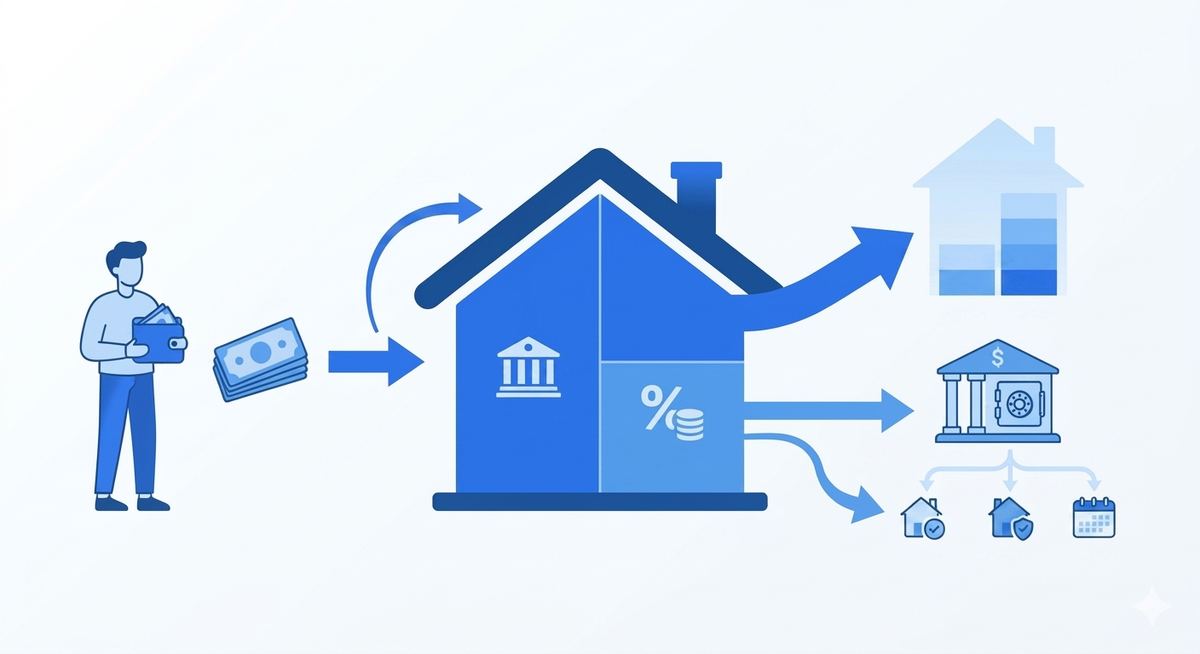
If you've ever looked at a mortgage quote and wondered why your payment is made up of several different numbers, you're not alone. A mortgage payment isn't just "pay back what you borrowed" — it's a bundle of several distinct costs, each calculated differently.
This guide breaks down exactly what you're paying for every month, how the math behind it works, and why your balance seems to shrink so slowly in the early years.
What's actually in your monthly payment
Most mortgage payments are commonly referred to by the acronym PITI: Principal, Interest, Taxes, and Insurance. Each piece serves a different purpose.
Principal is the portion that actually reduces what you owe on the loan. Interest is the lender's charge for lending you the money, calculated as a percentage of your remaining balance. Property taxes are collected by your local government and are often bundled into your payment and held in escrow until they're due. Homeowners insurance protects the home itself, and many lenders require it to be paid the same way.
Some payments also include a fifth item: private mortgage insurance (PMI), which typically applies if your down payment was below 20% on a conventional loan.
Why early payments feel like they barely move the needle
This is the part that surprises most new homeowners. In the early years of a mortgage, the majority of each payment goes toward interest, not principal — even though the total payment amount stays the same every month.
The reason is simple once you see it: interest is calculated on your current balance. Early on, your balance is at its highest, so the interest portion is at its highest too. As the balance slowly declines, less of each payment is needed to cover interest, so more of it goes toward principal instead. This gradual shift is called amortization.
By the later years of a 30-year loan, the ratio flips dramatically — the vast majority of each payment finally goes toward principal.
Fixed-rate vs. adjustable-rate: why it matters for this math
Everything above assumes a fixed-rate mortgage, where your interest rate never changes for the life of the loan. This is what makes amortization schedules predictable and calculable in advance.
Adjustable-rate mortgages (ARMs) start with a fixed rate for an initial period, then adjust periodically based on market rates. This means the payment breakdown described above can shift unpredictably once the adjustable period begins — worth knowing if you're comparing loan types.
A real example
On a $320,000 loan at 6.5% interest over 30 years, the very first payment is roughly $2,022 — but only about $270 of that goes toward principal. The remaining $1,752 covers interest alone. Fast forward 20 years, and that same $2,022 payment splits very differently: roughly $1,300 goes to principal and only about $722 to interest. The total payment never changed — only how it's divided did.
Frequently Asked Questions
Related Calculators
Mortgage Calculator
Estimate your monthly mortgage payment and view the full amortization schedule.
Amortization Calculator
See a full month-by-month breakdown of any fixed-rate loan's principal and interest.
Mortgage Payoff Calculator
See how much interest and time you could save by paying extra on your mortgage.
Published January 20, 2026. This article is for general informational purposes only — read our disclaimer.