Debt & Credit · January 25, 2026 · 5 min read
Debt Snowball vs Debt Avalanche: Which Method Wins?
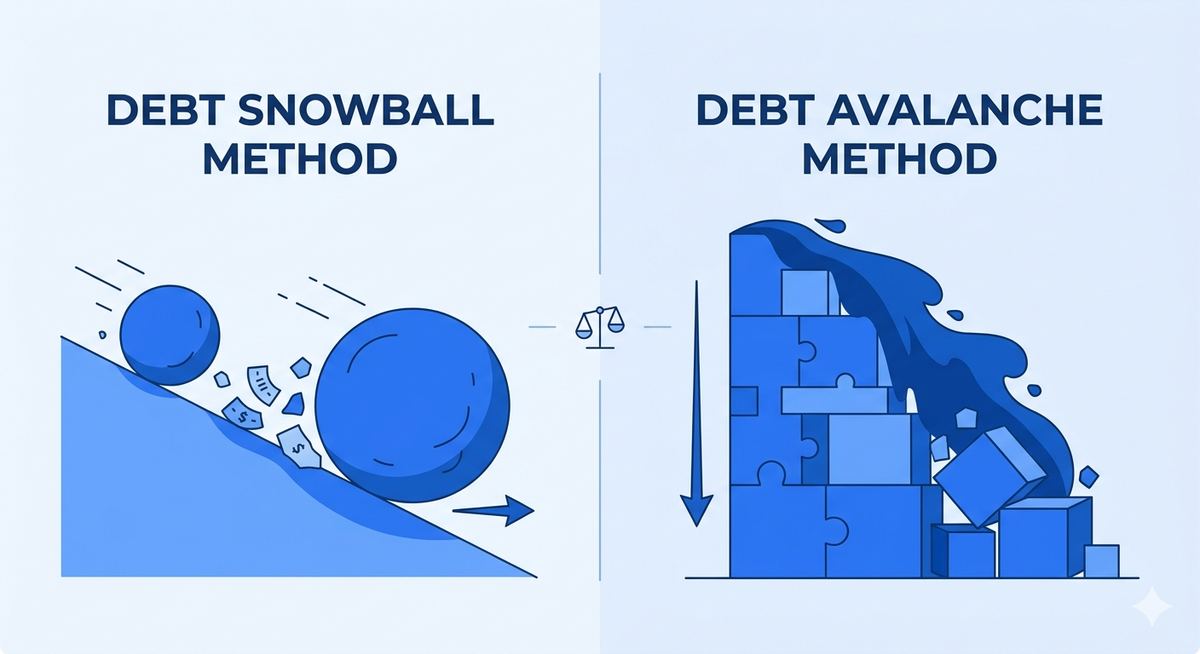
If you're paying off multiple debts at once, the order you attack them in genuinely matters — both for how much interest you'll pay and for whether you'll stick with the plan. Two strategies dominate the conversation, and they optimize for different things.
The debt avalanche: minimize total interest
With the avalanche method, you pay minimums on every debt, then direct all extra money toward the balance with the highest interest rate, regardless of its size. Once that's paid off, you move to the next-highest rate.
This method mathematically guarantees the lowest possible total interest paid across all your debts, since you're always attacking the most expensive balance first.
The debt snowball: build momentum
With the snowball method, you pay minimums on every debt, then direct extra money toward the smallest balance first, regardless of its interest rate. Once it's fully paid off, that freed-up payment rolls onto the next smallest balance.
This method typically costs somewhat more in total interest than avalanche, but many people find the quick wins of fully eliminating individual debts more motivating — which matters if staying consistent is the real challenge.
Which one should you actually use?
If the interest rate difference between your debts is large, avalanche's savings can be substantial, and it's worth the extra patience. If your debts have similar interest rates, the practical difference between methods shrinks, and snowball's motivational boost may be the deciding factor.
The honest answer from financial research: the best method is the one you'll actually stick with. A slightly more expensive plan you follow through on beats a theoretically optimal plan you abandon halfway.
A side-by-side scenario
Say you have a $3,000 balance at 22% APR and a $6,000 balance at 18% APR, with $100 extra to put toward one of them each month. Avalanche targets the $3,000 balance first (higher rate), saving more in total interest. Snowball also targets the $3,000 balance first in this case, since it happens to be both the smaller balance and higher rate — but if the numbers were reversed, the two methods would diverge and produce different total interest costs.
Frequently Asked Questions
Related Calculators
Debt Avalanche Calculator
Minimize total interest paid by targeting your highest-interest debt first.
Debt Snowball Calculator
Pay off multiple debts fastest psychologically by targeting the smallest balance first.
Debt Payoff Calculator
See how long it will take to pay off a balance and how much interest you'll pay.
Published January 25, 2026. This article is for general informational purposes only — read our disclaimer.