Mortgage & Real Estate · January 21, 2026 · 6 min read
15-Year vs 30-Year Mortgage: Which Should You Choose?
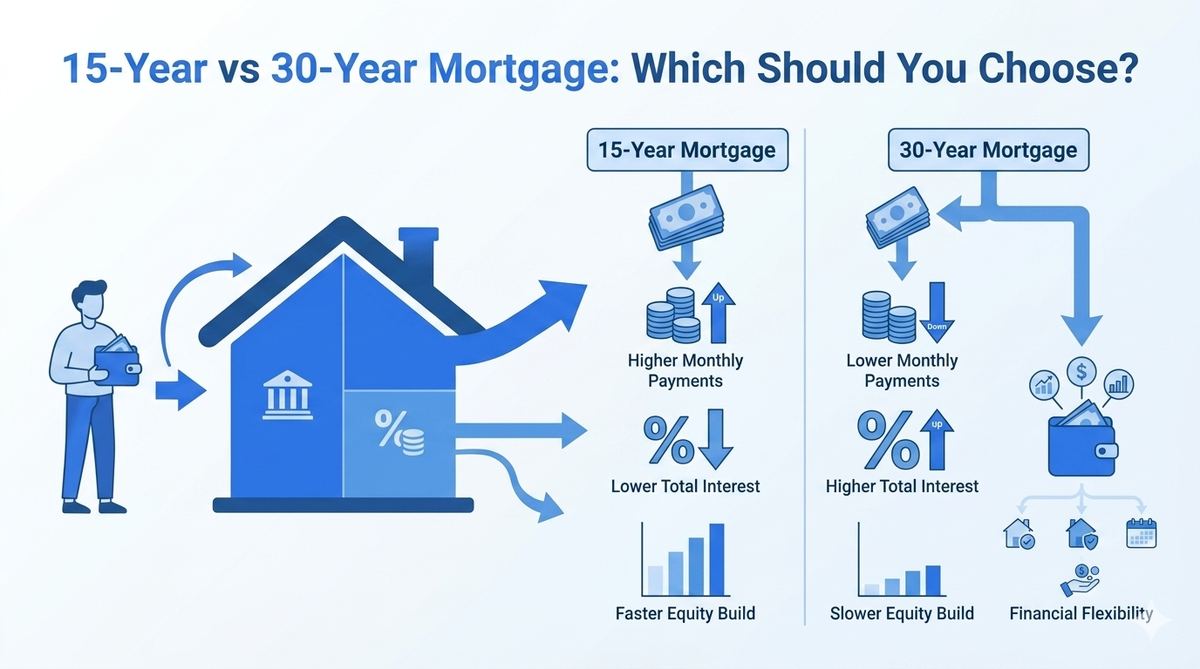
The loan term you choose affects your monthly budget, your total interest cost, and how quickly you build equity — and the right answer depends on more than just which number looks smaller on paper.
Here's a clear look at how these two common mortgage terms actually compare, so you can weigh the tradeoff for your own situation.
The core tradeoff
A 15-year mortgage pays off the loan in half the time of a 30-year mortgage, which means a larger portion of each payment goes toward principal from day one. This gets you to full ownership faster and saves a substantial amount in total interest.
A 30-year mortgage spreads the same loan amount over twice as many payments, which lowers the monthly payment significantly — often making it the only realistic option for buyers who need to keep monthly housing costs manageable.
Interest rates usually favor the shorter term
Lenders typically offer a lower interest rate on 15-year loans compared to 30-year loans, since the lender's risk is reduced over a shorter repayment period. This compounds the interest savings even further beyond just the shorter timeline.
What you give up with a 15-year term
The higher monthly payment is the obvious tradeoff, but it's worth thinking about less obvious effects too. A larger required payment leaves less monthly flexibility for other financial goals — retirement contributions, an emergency fund, or simply weathering an unexpected expense.
Some financial planners recommend a middle path: take the 30-year loan for its lower required payment and lower monthly risk, then voluntarily pay extra toward principal when your budget allows. This gives you 30-year flexibility with the option to pay off closer to a 15-year timeline if your finances stay strong.
A side-by-side example
On a $320,000 loan, a 30-year term at 6.5% runs about $2,022/month and accrues roughly $407,000 in total interest over the life of the loan. The same $320,000 at a 15-year term and a typically lower rate of around 6.0% runs about $2,701/month — a noticeably higher payment — but accrues only around $166,000 in total interest, a difference of over $240,000.
Frequently Asked Questions
Related Calculators
Mortgage Calculator
Estimate your monthly mortgage payment and view the full amortization schedule.
Mortgage Payoff Calculator
See how much interest and time you could save by paying extra on your mortgage.
Refinance Calculator
See how much refinancing could save you and how long it takes to break even on closing costs.
Published January 21, 2026. This article is for general informational purposes only — read our disclaimer.